Published July 6, 2026
Updated July 6, 2026 | 8 min read
Primary Keyword: PA warehousing capabilities

A practical guide to Pennsylvania warehousing capabilities for companies storing, staging, converting, and shipping paper, packaging, and industrial materials.
Pennsylvania is a practical warehouse location for companies serving the Northeast and Mid-Atlantic. It offers access to dense customer markets, major ports, interstate corridors, regional manufacturing, and cross-border lanes. For paper, packaging, and industrial materials, location can influence freight cost, response time, and customer delivery confidence.
The Search Console export includes PA warehousing capabilities as a non-brand opportunity. That phrase suggests a buyer is evaluating what a facility can actually do, not just whether space is available. The Bengal Group should answer with specifics: square footage, docks, rail, inventory systems, cross-docking, converting, and customer support.
Square footage is only the beginning. A warehouse buyer needs to know whether the provider can receive efficiently, protect material, maintain inventory accuracy, stage outbound loads, communicate status, and respond to exceptions. For paper and packaging customers, handling experience matters because damage can quickly erase savings from a cheap storage rate.
The Bengal Group's 225,000-square-foot campus, 16 loading docks, rail switch, 24/7/365 support, SAP and EDI-ready inventory workflows, and converting operations create a broader capability set than ordinary overflow space. The right SEO content should explain how those assets work together.
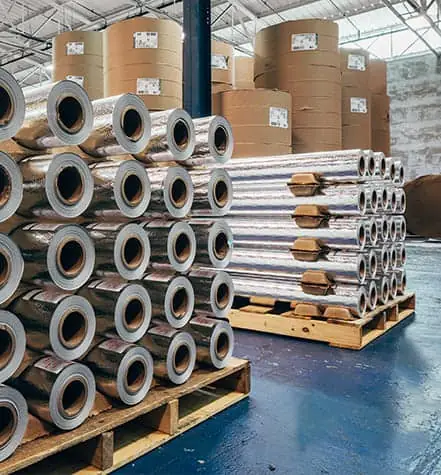
Paper rolls, paperboard sheets, films, PVC, nonwovens, and packaging components require more care than generic pallet storage. The warehouse team has to understand roll condition, edge protection, stack alignment, wrap, labels, lot control, and the timing requirements of downstream production.
A warehouse that also understands converting can add value before and after storage. Parent rolls may be staged for sheeting or rewinding. Damaged material may be reviewed for restoration. Finished output may be held for customer release. This is why The Bengal Group should not separate its warehouse story from its converting story.
Buyers should ask whether the provider can support the material type, volume pattern, inbound mode, storage duration, release cadence, reporting requirements, and exception process. They should also ask whether the provider can support cross-docking, rail-to-truck transfer, packaging, labeling, converting, or restoration if the program changes.
The Bengal Group can answer many of those questions with facility and process proof. That is the value of a capability-focused page. It helps a buyer move from broad warehouse search to a qualified conversation about what their material needs, where it is coming from, and how quickly it has to move.
The Bengal Group's value is not only that it has space in Pennsylvania. The stronger story is that the space is attached to converting equipment, cross-docking capability, rail access, dock capacity, inventory visibility, and a team that handles paper and packaging materials. That combination can reduce the number of vendors a customer has to coordinate.
For buyers comparing PA warehousing capabilities, this matters because their real problem is usually not just storage. They may need overflow material staged before production, parent rolls converted before release, customer orders cross-docked, or finished inventory tracked accurately for customer service. The Bengal Group should be evaluated as an operating partner, not only as square footage.
The Bengal Group offers warehousing, cross-docking, inventory visibility, rail and truck handling, 16 docks, converting-adjacent staging, and distribution support from Pennsylvania.
Yes. Pennsylvania can provide access to major Northeast and Mid-Atlantic markets, ports, highways, and manufacturing corridors.
Yes. The Bengal Group supports paper rolls, paperboard, packaging materials, industrial materials, and converted output with warehousing and logistics workflows.